Leak Detection for Compressed Air and Gases
Making energy losses visible and turning them into savings
Studies show that up to 30 percent of the generated compressed air volume is lost through undetected leaks. The result is high energy costs, overloaded compressors, and inefficient compressed air production. Therefore, it is essential to identify, monitor, and repair leaks in compressed air systems. Modern leak detection methods allow precise localization of leaks, which can then be permanently fixed by qualified personnel.
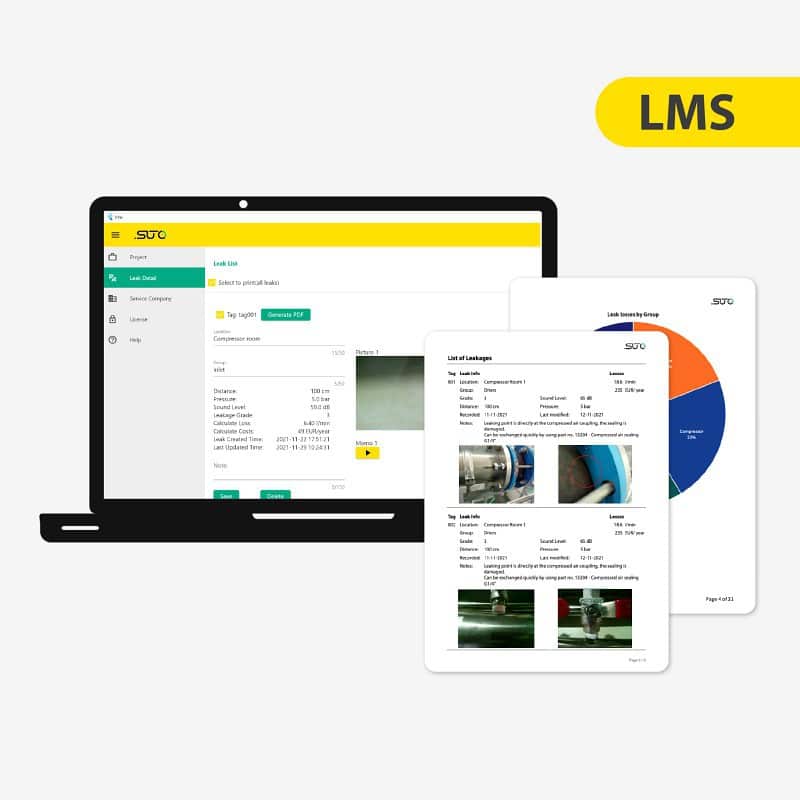
SUTO iTEC offers ultrasonic leak detection instruments that are easy to use. This is complemented by the LMS Leak Management Software, which generates audit reports with one click and supports efficient energy management.
SUTO iTEC Leak Detectors and Software
SUTO iTEC offers modern solutions for the efficient detection and analysis of compressed air leaks. They enable fast localization, quantification and documentation to save energy and ensure system performance.
Why Early Leak Detection Matters
Leaks in compressed air and gas systems often develop gradually and remain unnoticed for long periods. During this time, energy consumption rises because compressors must run harder to maintain the required operating pressure. These hidden losses accumulate over months and can significantly increase operating costs. Early leak detection prevents this escalation by ensuring that leaks are identified and repaired before they impact system performance.
Modern ultrasonic technology and acoustic leak cameras with visual leak mapping make even the smallest leaks immediately detectable and provide clear guidance on their exact location. This allows for targeted repairs without unnecessary downtime. At the same time, operators gain a transparent overview of the system’s overall condition. Regular inspections improve efficiency, reduce energy consumption, and contribute to a stable and reliable compressed air or gas supply.
Costs and Savings Potential Illustrated with an Example
Many companies wonder: What does leak detection in their compressed air system cost, and is the effort worthwhile?
The answer is: Yes. Eliminating just a few medium-sized leaks can yield annual savings in energy costs ranging from four to five figures. Today, there are clear tools and tables available for calculating compressed air leaks, making it easy to determine the savings potential.
A concrete example
A leak with a diameter of just 2 mm causes a compressed air loss of approximately 3 l/s, or around 180 l/min, at a working pressure of 7 bar. This corresponds to annual additional costs of about 1,200 euros with 8,000 operating hours. The sooner you act, the greater the impact.
Where Can Leaks Occur in Compressed Air Systems?
Leaks are among the most common maintenance issues and can occur anywhere in the system. They require careful localization and subsequent repair.
Leaks frequently occur at the following points in the compressed air system:
-
Fittings, pipes, hoses, and couplings: Undetected Push-to-Lock connections and improperly installed hoses are among the most common causes of compressed air losses.
-
Open condensate traps: Improper operation, contaminated seals, and defective valves are frequent problem sources that can lead to inefficient operation.
-
Regulators, lubricators, and filters: Incorrect installation or inadequate maintenance can lead to leaks and thus a drop in pressure.
-
Connection separations: Missing or damaged O-rings can compromise the sealing of connections and lead to leaks.
-
Shut-off and control valves: Worn seals on the shaft can also lead to leaks, reducing system efficiency.
-
Point-of-use devices: Poorly maintained or outdated devices may exhibit internal leaks that increase compressed air consumption.
-
Thread sealants: Improperly applied or unsuitable thread sealants can cause leaks and jeopardize system integrity.
-
Flanges: Missing welds or inadequate seals are common issues that can lead to pressure losses.
A systematic leak check with professional leak detection devices helps to quickly identify and address these leaks, ideally as part of regular energy monitoring.
Ultrasonic Leak Detection – The Modern Method
Ultrasonic measurement is one of the most effective methods for locating compressed air leaks. This technique captures the high frequency sounds generated when compressed air escapes and converts them into audible signals. It allows precise identification of leaks, even in noisy environments, helping operators optimize compressed air consumption and reduce operating costs.
In addition to handheld ultrasonic devices, modern acoustic leak camera technology uses an array of ultrasonic microphones to visualize leaks directly on a live image. This makes it possible to scan large areas quickly and pinpoint leak locations with high accuracy, even in complex or hard to access installations.
The advantages of ultrasonic and acoustic leak camera detection
- Reliable detection of even the smallest leaks
-
Independent of ambient noise levels
-
Quick and easy application with minimal training
-
Testing possible during operation
- High detection accuracy through directional signal capture and visual mapping
Wireless headsets, visual displays, and advanced filtering functions ensure efficient and comfortable use, even in loud industrial environments.
Devices for Your Leak Detection Needs
SUTO ITEC offers a comprehensive range of leak detection devices designed for professional use. Our solutions for leak detection in compressed air systems combine powerful ultrasonic technology with user-friendly operation and integrated data collection. They enable precise and efficient identification of leaks, helping you reduce operating costs and maximize the efficiency of your compressed air systems.
Leak Detection Devices at SUTO iTEC
Our product range includes various models for reliable leak detection:
-
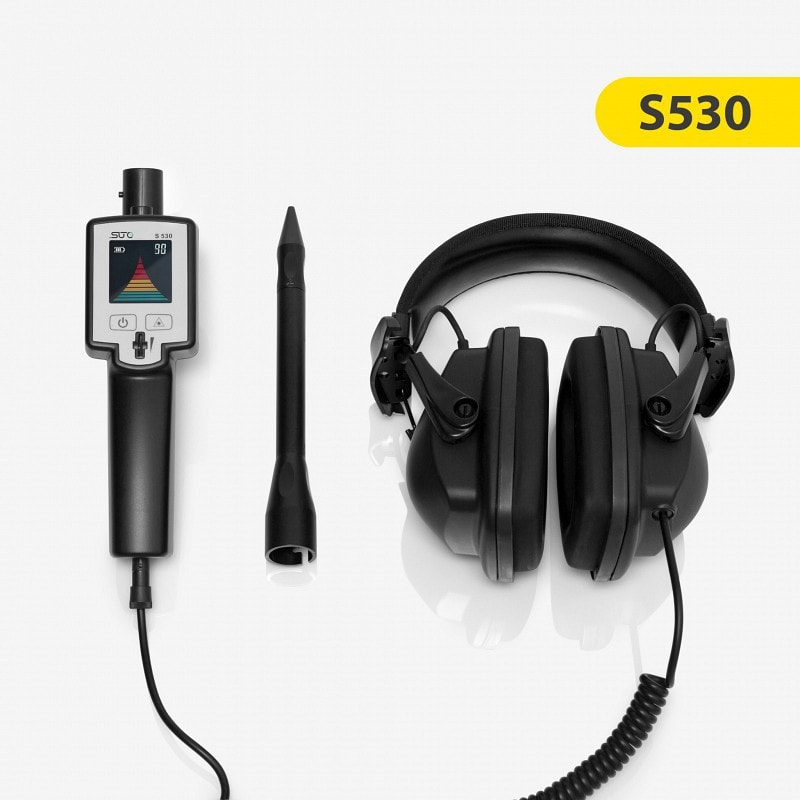
S530 Ultrasonic Leak Detector
A cost-effective, portable device for quick and precise leak detection. Ideal for simple maintenance tasks. -
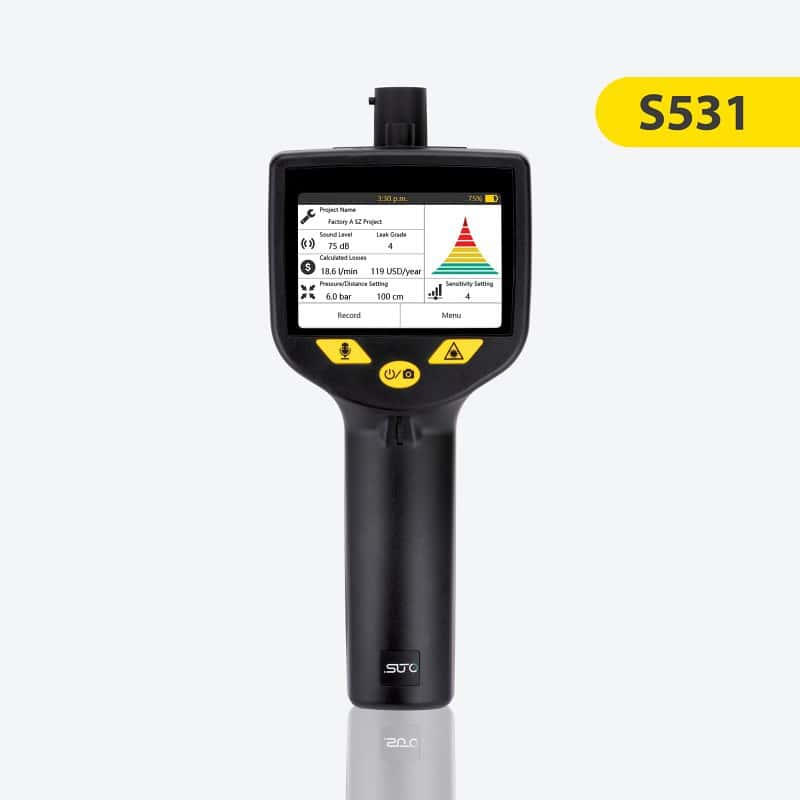
S531 Smart Ultrasonic Leak Detector
A high-precision device with integrated data logging and an LMS license for automatic report generation. -
S532 Acoustic Leak Detection Camera
Allows for the visualization of multiple leaks using acoustic imaging. Perfect for complex systems. Fully integrated with the LMS for automated documentation.
Advantages of Our Leak Detection Devices
Our product range includes various models for reliable leak detection:
-
Robust design for industrial applications
-
Precise localization of leaks in the compressed air network
-
Documentation and data capture within the device
-
Generation of audit reports for ISO 50001 compliance
-
The leak detection kit includes the LMS software license at no additional cost
In combination with our LMS Leakage Management Software you can create automated leakage reports, track remedial measures and reduce compressed air leaks in the long term.
FAQs – Common Questions
How much compressed air is typically lost through leaks?
The US Department of Energy estimates that leaks waste 20 to 30 percent of a compressor’s output in a typical industrial plant. Well-maintained systems reach 5 to 10 percent, and that is the level worth targeting. If your network has never been surveyed, assume you are nearer the upper end: leakage is invisible on any gauge and grows quietly year after year.
What does a single leak cost per year?
More than most people expect, because a leak runs 8,760 hours a year while your production does not. A 2 mm hole at 7 bar loses roughly 3 l/s of free air. That is about 1.2 kW of continuous compressor power, or around 1,200 euros a year at 8,000 operating hours. Ten leaks of that size cost as much as an additional compressor running permanently. Your exact figure depends on the specific power of your station, typically 0.10 to 0.12 kWh/m³ at 7 bar, and on your electricity tariff.
Can leaks be detected while production is running?
Yes, and that is exactly the point of ultrasonic detection. A leak only makes a sound while the system is pressurised, so the survey has to take place during normal operation. The ultrasound generated by escaping air lies far above machine and process noise and is highly directional, so the detector picks out the leak rather than the plant around it. No shutdown, no depressurising, no production loss.
Which leak detector do I need: S530, S531 or S532?
It depends on what you need to do with the leak once you have found it.
- S530 is the cost-effective entry point. It locates leaks reliably with focus tube and headset, and is the right choice when a maintenance team simply needs to find and repair.
- S531 adds a colour touch screen, a 5 MP camera, voice notes, storage for 500 records and automatic calculation of leak rate and cost. It comes with 100 leak tags and an LMS licence, so it is the right choice when you need to report and prioritise, not just find.
- S532 is an acoustic imaging camera with a 64-microphone array that shows leaks as a colour overlay on the live camera image, from 0.3 up to 100 m. It is built for large sites, overhead pipework and scanning whole zones from the ground.
Can the device also tell me how large the leak is?
The S531 and the S532 both calculate a leak rate and an annual cost. They derive it from the measured sound level together with the system pressure and the distance to the leak, which you enter in the device. Treat the result as a well-founded estimate rather than a calibrated flow measurement, and with the S531 keep the measuring distance below about 1 m for the best result. Where a verified total is needed, cross-check the sum of the individual leaks against a flow meter reading taken during non-production hours.
How often should a leak survey be repeated?
Quarterly is the interval recommended by the US Department of Energy and the Compressed Air Challenge, and it is what works in practice. Leaks are not a one-off defect: vibration, thermal cycling, flexing hoses and ageing seals produce new ones continuously, so the benefit of a single survey degrades within months. Large sites often divide the plant into four zones and survey one zone per quarter, which spreads the effort and keeps the whole network on a rolling twelve-month cycle.
Can I also use the detector on nitrogen, vacuum or other gases?
Yes. Ultrasound is generated by the turbulence of gas escaping through an opening, not by the gas itself, so the method works on nitrogen, oxygen, argon, CO2 and other compressed gases just as it does on air. Vacuum leaks are detectable too, because the same turbulence occurs as air rushes inward, although the signal is weaker and you generally need to work closer to the leak. The S532 additionally detects partial discharge on electrical equipment. One limitation worth knowing: ultrasound locates a leak but cannot identify which gas is escaping.
Conclusion: Leak detection as a basis for cost reduction and energy savings
Leak detection of compressed air is the first and most important step in sustainably preventing compressed air losses, increasing the efficiency of your compressed air station and reducing your energy costs. With leak detection devices from SUTO ITEC, you are making an economically and ecologically sensible decision for your company.
Contact us for individual advice or an on-site demonstration. Our experts will help you to realize your savings potential.